Monoblock Filling Machine for Bottle Filling and Capping
A monoblock filling machine combines filling and capping on one frame, so bottles pass from fill head to cap head without leaving the unit. Newpeak builds these integrated units and the complete bottling lines around them in Zhangjiagang, Jiangsu, China.
- Export experience
- 12 years
- Turnkey line lead time
- 45–60 days
What a Monoblock Filling Machine Does on a Bottling Line
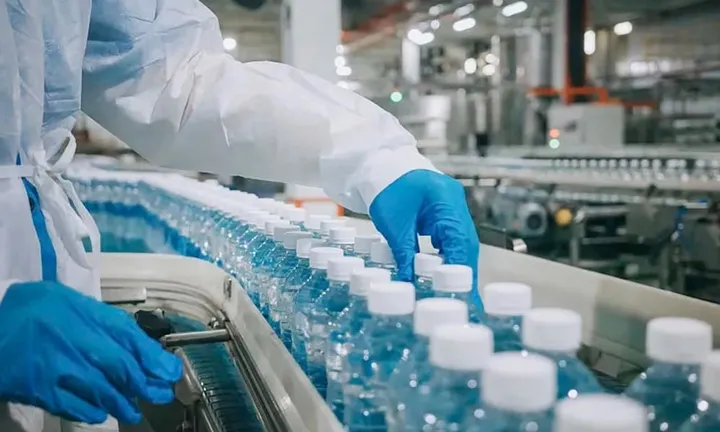
A monoblock filling machine places the filling and capping stations on one common frame, driven as a single unit, with a short transfer between the fill carousel and the cap chute. Common configurations pair a rinser, filler and capper for water and juice, or a filler and capper for oils and other viscous liquids. Integration suits bottles that stand stably when full, caps that seat in one simple motion, and products of consistent viscosity. Separate machines remain practical when the cap type changes often or when filling runs slower than capping. Selection follows confirmed bottle, cap and output specifications; an inquiry with those details starts a configuration.
Frames vary from a rinse-fill-cap unit to a 5-in-1 integrated machine that adds labeling and coding after capping. Because the stations share one drive, output is set by the slowest station, so a slow capping action limits the filler. Where cap formats change between products, quick-release cap chutes and a separate cap feeder reduce changeover work. Filling valves, cap chucks and bottle handling parts are machined in 304 or 316 stainless steel for washdown.
Filling and Capping Machine Configurations
A filling and capping machine built as one unit moves each bottle from the fill carousel to the cap chute on a transfer star wheel, with no buffer between the two steps. Integration works when the product is consistent, the filled bottle is stable on the transfer, and the closure seats with a screw or press action. Separate filling and capping machines suit frequent closure changes, products with large particulates, or output where the two steps run at clearly different rates. Cleaning, sanitizing and changeover procedures must cover the whole frame, including the cap chute and transfer parts.
In a complete beverage filling line, the monoblock bottling machine sits after the bottle unscrambler or rinser and before labeling, coding and packing equipment. The infeed needs a steady bottle supply, and the outfeed needs accumulation to absorb short stops at the labeler. Utilities include compressed air, rinse water, product supply and electrical power, sized for every station on the frame. Line control links the monoblock to the machines on either side, so a stop propagates cleanly. Layout follows product, bottle and output requirements rather than a fixed template.
The filler inside a liquid filling and capping machine is chosen by how the product behaves. Gravity fillers suit low-viscosity liquids, pressure fillers suit carbonated products, and flowmeter or piston fillers cover medium and high viscosity. Foaming liquids need slower fill curves, bottom-up filling or anti-foam nozzles; products with particulates need wider product paths and gentle valve action. The capping head must match the closure, whether screw, press-on or pilfer-proof. Viscosity, filling temperature, foaming behaviour and particulate size are the details that decide the configuration.
- Liquid viscosity, filling temperature, foaming tendency and any particulates.
- Bottle material, shape, neck finish, and the cap type, size and closure style.
- Required output, checked against the slowest station on the frame.
- Cleaning routine, changeover steps and the parts that touch product.
- Compressed air, water, power and floor space at the installation point.
- How the monoblock liquid filling machine connects to existing upstream and downstream equipment.
Integrated Frames Newpeak Builds and How a Monoblock Project Runs
Newpeak builds integrated frames across several product families: a Washing-Filling-Capping Machine (3-in-1) for water bottling, an Automatic Juice Washing Filling Capping 3in1 Machine (Monoblock Type) for juice lines, a Beer Washing Filling Capping Machine (BGF Series), and a 5-in-1 integrated machine that adds labeling and coding to rinsing, filling and capping. Water treatment systems, bottle blowers, pasteurizers and labeling and packaging machines complete a line.
Newpeak is a manufacturer of beverage filling and packaging machinery based in Zhangjiagang, Jiangsu, China, with a plant covering 4,259 m² and over 16 years of experience building filling equipment. The team includes 10 R&D engineers and 3 QA/QC inspectors. Newpeak has 12 years of export experience and became a formal member of the China Beverage Machinery Association in 2020.
Standard filling machines are usually delivered within 25–35 days, while customised turnkey lines take 45–60 days depending on configuration. Payment is accepted by T/T, L/C or Alibaba Trade Assurance order. A configuration proposal, layout drawing and utility list follow once product, bottle, cap and output details are confirmed through the contact page.
How an order runs
- Send your details
- Product, bottle or container size, closure type and the output you need in bottles per hour.
- Configuration and layout
- Newpeak proposes the machine or line configuration and a layout for your building.
- Order and payment
- Payment by T/T, L/C or Alibaba Trade Assurance orders.
- Manufacturing
- Standard Newpeak filling machines are usually delivered within 25–35 days; customised turnkey production lines take 45–60 days depending on configuration.
- Shipping and start-up
- The equipment ships with documentation, and installation and commissioning support is arranged with your team.
Request a quotation
Send your product, container type and output; we will propose a matching model.
Or write to sales@bottlefillingsystems.com